
With sedentary work schedules, long commutes, and frequent standing, more and more office workers are using compression socks for women to relieve leg fatigue, reduce swelling, and improve circulation. It’s indeed a useful tool, but many people overlook one crucial point: even the best products have their limits.
If your body is already sending discomfort signals, forcing yourself to wear them may actually worsen the problem.
This article systematically explains, from the perspective of actual office and daily wear scenarios, when compression socks are a plus, when to stop using them, and how to determine if your body is refusing to continue wearing them.
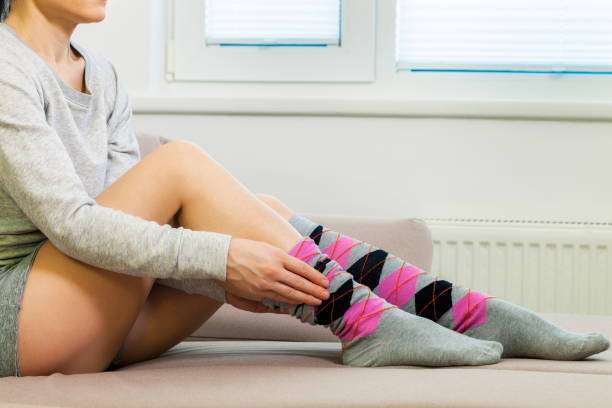
Why are more and more office workers starting to wear compression socks for women?
Modern office environments are characterized by two main features: prolonged sitting and staring at screens. Reduced lower limb activity slows circulation, easily leading to heavy legs, swollen feet, and noticeable sock marks. Compression socks for women feature a gradient pressure design, applying maximum pressure to the ankle and gradually decreasing upwards to promote blood flow.
In real-world office settings, it is often used for:
- Sitting for long periods of time writing proposals
- Meetings lasting several hours
- Long standing time during commuting
- Business trip by plane or high-speed rail
- High foot traffic during exhibitions or events
Many people consider compression socks for women as “invisible office equipment.”
But it’s important to clarify that they are auxiliary tools, not daily necessities that must be relied upon around the clock.
A common misconception: the tighter, the better.
Many people who encounter compression socks for women for the first time have an intuitive judgment—the tighter they are, the better the effect. In fact, this is a typical misconception.
The key to compression stockings is not “tightness” but “proper distribution.”
When the pressure exceeds the leg’s tolerance, it will not only fail to improve circulation but may also cause localized compression.
Common mistakes to insist on include:
- It only proves that it is effective if you feel that it is.
- Continue wearing it even when you feel numbness
- Indentations are considered normal
- Even if you’re not feeling well, you can persevere all day.
Compression socks for women are designed to facilitate circulation, not create new resistance. Once the direction is reversed, they should be stopped.
Four types of signals your body is telling you to take a break
Persistent numbness or tingling
It’s normal to feel slightly tight when you first put them on, but if you still feel numbness or tingling after wearing compression socks for women for 30 minutes, it usually means that the size or pressure level is not right.
Someone in the office experienced numbness in their toes in the afternoon because they chose a size too small. They initially thought it was due to the air conditioning being too cold, but after taking them off, they discovered the problem was that the socks were too tight.
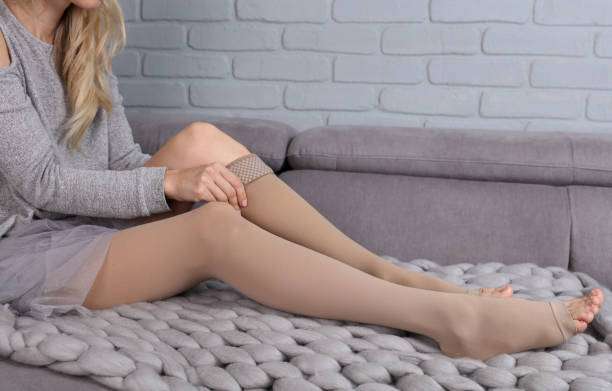
The marks are deep and heal slowly.
Compression socks for women will leave light marks, but it’s not normal if the following occurs:
- A distinct deep groove
- Local color abnormality
- It hasn’t recovered after two hours.
- It is painful when pressed.
This indicates excessive local pressure, and use should be suspended.
The more you wear it, the more bloated it becomes, rather than the lighter it feels.
A normal experience should be that your legs feel more relaxed. If you feel heavier, tighter, or more bloated after wearing them, possible reasons include:
- Incorrect pressure level selected
- The fabric is stuffy
- Wearing for too long
- Legs were swollen that day
In these situations, continuing to wear compression socks for women will not “adapt” to the environment; it will only add to the burden.
Skin sensitivity reaction
Some people are sensitive to elastic fibers or dyes. Compression socks for women cover a large area of skin, and if the material is unsuitable, problems can easily occur:
- Localized redness
- Small rashes
- Itch
- Burning sensation
This is not an adaptation period but a signal that it’s time to change the materials.
Wearing duration: longer is not necessarily better.
Many people wear compression socks for women from morning till night, believing that this makes the effect more stable. In fact, compression products also need “intervals.”
A more reasonable pace is:
- Wear for commuting
- Wear during prolonged sitting
- Wear during the meeting
- Take off your clothes and relax during lunch break
- Finish dressing after returning home
It is generally not recommended for women to wear compression socks to sleep; it is better to allow the legs to recover naturally overnight.
How to quickly determine if it is suitable
A simple “one-hour testing method” can be used:
Wear it and move around for 30–60 minutes, then observe:
- Is it warm rather than cold?
- Is it tight but not constricting?
- Is there no numbness?
- Whether to walk naturally
- Are there any obvious pain points?
If these conditions are met, these compression socks for women are usually a good match.
Smarter ways to use the office
Compression socks for women don’t have to be worn every day; they can be chosen based on workload.
- Project sprint week
- Sitting for long periods writing reports
- Wearing clothes while traveling
- Long-term training day wear
A relaxed workday can reduce dependence. This is effective while avoiding overuse.
Pressure Level Selection Logic
When choosing compression socks for women, the stress level is more important than the color.
Common hierarchical approaches:
| Pressure Level | Use Case |
|---|---|
| Light pressure | for daily sitting |
| Medium pressure | prolonged standing or walking |
| Higher pressure | Long-distance travel |
For most office settings, light- or medium-pressure compression socks for women are sufficient; high-pressure socks are not suitable for everyday wear for extended periods.
Incorrect pairings can amplify discomfort.
Even if the product itself is fine, incorrect pairing can create added stress:
- High heels layered with compression socks for women
- Tight pants layered with compression stockings
- Thick fabric for hot and humid environments
- Sitting cross-legged for a long time
These factors can all cause abnormal local stress.
Ignoring dimensional measurements is one of the biggest pitfalls.
Many people choose compression socks for women based solely on their height and weight, which is insufficient. A more scientific method is to measure:
- Ankle circumference
- Calf circumference
- Calf length
Only with the right size will the pressure be distributed correctly; otherwise, the difference in experience will be very noticeable.
FAQ (Frequently Asked Questions)
Q1: It feels tight when I first put them on; do I need to get used to it?
A: Slight tightness is normal, but there shouldn’t be any numbness or pain. If there is significant discomfort, these compression socks for women are not suitable.
Q2: Can I wear it every day?
A: You can use it as needed, but it is not recommended to rely on compression socks for women every day for extended periods without any difference.
Q3: Will it help if my legs are swollen in the afternoon?
A: You should lift your legs to relax them first before deciding whether to wear compression socks for women, instead of forcing yourself to put them on.
Q4: Can I still wear the rolled-up hem?
A: Rolled-up hems can cause localized high pressure, so it is not recommended for women to continue wearing these compression socks.
Q5: Will the cold office air conditioning affect my experience?
A: Yes. Low temperatures can amplify the feeling of pressure. You might consider thinner compression socks for women.
End
The true value of compression socks for women lies in “fit” and “comfort,” not in endurance.
The truly effective way to use them is to adjust them flexibly based on your body’s feedback, rather than treating them as a piece of equipment that must be worn consistently.
When tightness becomes oppression and support becomes a burden, it’s time to stop and make a new choice.
If you’re planning to buy compression socks for women, prioritize styles with clearly defined compression levels, precise size ranges, and breathable fabrics, starting with lighter compression.
Choosing a pair that provides more support than firm support is crucial. Only a truly well-fitting pair of compression socks for women can offer stable and comfortable support during your work and commute.