
Compression socks for women have become an important tool for daily leg care. Whether you’re sitting at a desk for long periods, standing for long periods, experiencing swelling during pregnancy, or recovering after exercise, properly fitting compression socks can effectively promote blood circulation in the legs and reduce swelling and soreness. However, with increased use, the elasticity and pressure of compression socks gradually decrease. If they aren’t replaced in time, they won’t provide the original therapeutic effect and may even affect leg health. So, how can you tell if the compression force of compression socks for women has decreased?
This article will help you gain a comprehensive understanding of compression principles, routine assessment methods, usage cycles, and maintenance techniques.

Compression socks for women: How compression works
Compression socks for women are designed with “gradient pressure” to apply different pressures to different areas:
The ankle area experiences the most pressure.
The pressure is second only to the mid-calf.
Minimal pressure on the thigh or above the knee
This design mimics the action of a muscle pump, helping blood flow from the lower limbs back to the heart, improving circulation, and reducing swelling and soreness. If compression stockings lose elasticity or their compression decreases, this “blood pump effect” weakens, and leg swelling, soreness, and fatigue may reappear.
assessing decreased compression strength in women’s compression socks
1. Visual and tactile inspection
Observe the appearance and feel of the compression socks:
Significantly decreased elasticity or sagging
The cuffs of socks tend to roll up.
The appearance of fibers, holes, or significant thinning in the material
are all early signs of a decrease in compressive strength.
After wearing compression socks for women for about a year, I noticed that the cuffs no longer fit snugly against my calves, and I started to experience slight swelling in my legs, which clearly indicated insufficient compression.
2. Elastic rebound test
method:
Stretch the compression socks for women to the appropriate length for your calves.
After releasing the sock, observe whether it quickly springs back to its original shape.
If the rebound is slow or fails to fully recover, it indicates a decrease in compressive force.
If the socks rebound normally, it means they are still usable.
3. Feelings while wearing it
Wearing compression socks for women, you should be able to feel:
There is a noticeable sense of support from the ankle to the calf.
Slight pressure but no pain
A slight firming sensation in the legs after prolonged sitting or standing, rather than sagging.
The key to determining whether the compression force has decreased is whether the wearing comfort has diminished:
My ankles used to feel very firm, but now they feel soft.
The feeling of lightness in the lower limbs has decreased, and swelling has reappeared.
This is also the most intuitive way for most women to make a judgment.
4. Use the periodic recording method
Compression socks for women are not permanently durable; their typical lifespan is about 3–6 months (wearing for 6–8 hours a day), depending on the material and compression level. Prolonged and frequent wear, excessive washing, or high-temperature drying will accelerate the decrease in compression.
Empirical formula reference:
Wear it for 8 hours a day, 5–6 days a week: the compression may decrease after 3–4 months.
Wearing it for 4–6 hours a day can extend the lifespan to 5–6 months.
Regularly recording usage time and leg condition can help determine whether compression socks for women need to be replaced.
5. Simple pressure measurement method (home version)
If you want to determine the compression force more accurately, you can try a simple pressure measurement method:
Lay the socks flat in your hands
Press your fingers evenly on the ankle area.
Feel the rebound force and resistance
The resistance is significantly reduced → the compressive force decreases.
The resistance is still sufficient. → This indicates that it can still be used.
For those seeking precision, a household spring scale can be used to measure the stretch of socks, but most women can judge by feel and how they feel when wearing them.
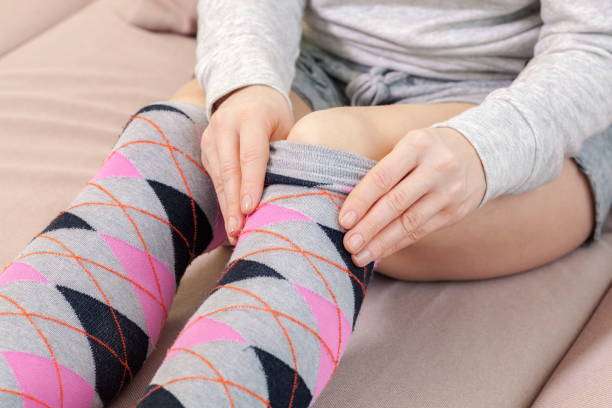
Common causes of decreased compressive force
Daily wear and tear,
Frequent putting on and taking off and prolonged wear cause sock fibers to gradually become fatigued.
Improper washing and care, such as
High-temperature washing, drying, bleaching, or the use of fabric softeners can damage fiber elasticity and lead to a decrease in compressibility.
Materials
such as nylon and spandex, will gradually lose their elasticity when subjected to long-term stress due to aging.
Wearing
Socks that are too big or too small will accelerate the loss of elasticity.
Techniques to prolong compression socks for women
1. Properly put on and take off
Slowly pull up from the toes
Avoid pulling with your fingernails
Avoid violent reversal
2. Clean properly
Handwashing is best, using cold or warm water.
Avoid high-speed rotation of the washing machine
Without using a dryer, high temperatures will damage the elastic fibers.
3. Rotate use
Have several pairs of compression socks for women on hand and wear them alternately.
Avoid wearing the same pair of shoes every day to extend their lifespan.
4. Storage Precautions
Avoid prolonged folding or squeezing.
Store in a dry, well-ventilated place, avoiding moisture.
Risks and impacts of decreased compressive force
If compression socks for women continue to be used despite a decrease in compression strength, the following effects may occur:
The swelling cannot be improved and
The original venous return assistance effect is weakened.
The increased soreness and swelling in the legs
made it difficult to effectively relieve the pressure in the lower limb veins.
The effects of improved circulation are diminished.
especially during pregnancy, prolonged sitting or standing, and recovery from exercise, significantly reducing the benefits to leg health.
Therefore, timely assessment and replacement of compression stockings are crucial for maintaining leg health.
Summarize:
Based on the above methods, to determine whether the compression force of compression socks for women has decreased, one can consider the following:
Appearance and feel → Sagging, damage, curling edges
Elastic rebound → Slow rebound after stretching
Wearing experience → Reduced support, decreased lightness in the legs
Usage period → More than 3–6 months
Simple pressure test method → Ankle resistance significantly reduced
At the same time, proper wearing, washing, care, rotation, and storage can extend the effective lifespan of compression socks, allowing compression socks for women to maintain good leg health support for a long time.
I have 3-4 pairs of compression socks for women at home with different compression levels, which I wear alternately and check for elasticity every 4-5 months. I replace them promptly when I notice a decrease in compression. This way, even with long hours working remotely, my calves don’t experience the same noticeable swelling and soreness as before, and my leg health has significantly improved.